Summary:
Compared to standard virgin foam, rebonded foam offers higher load-bearing capacity, better durability under repeated compression, and improved vibration control performance.
It is widely used in automotive interiors, industrial packaging, and machinery isolation. It is available in blocks, sheets, and custom-cut formats for precision engineering applications requiring consistent density and performance.
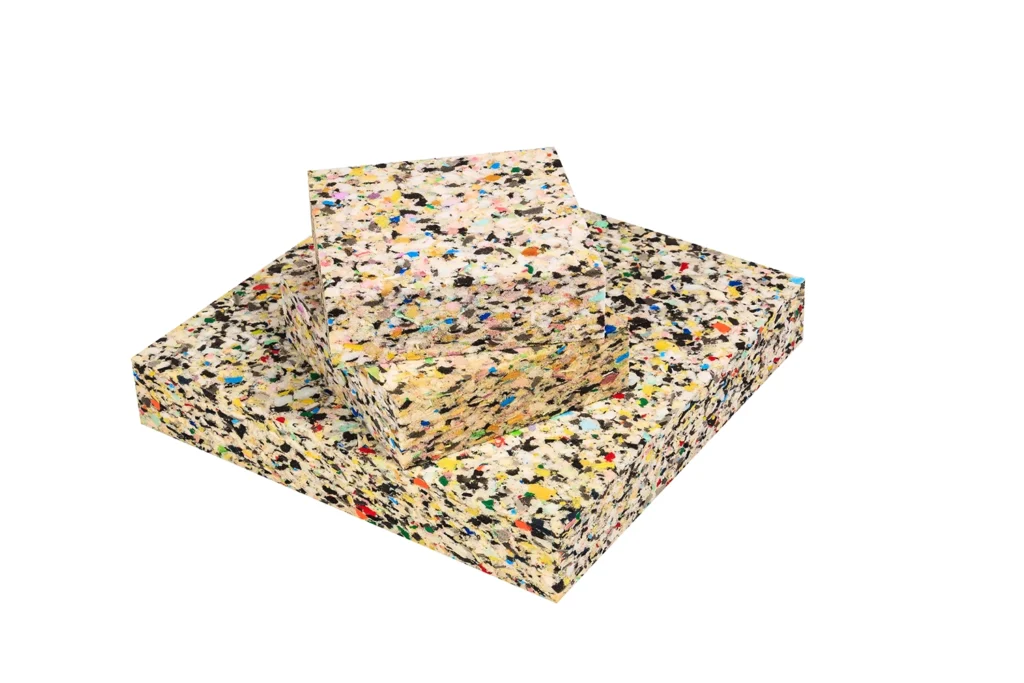
Rebonded foam is a high-density engineered foam material made from recycled foam scrap bonded under heat and pressure.
It is used in industrial and commercial applications where impact absorption, vibration reduction, and long-term structural stability are required at lower cost than virgin foam alternatives.
How Rebonded Foam Is Manufactured
Step 1: Shredding Post-Industrial Foam Scrap
The process begins by shredding post-industrial foam waste into granules.
This recycled input determines final density, firmness, and compression resistance of the material.
Step 2: Mixing with Polyurethane Binder and Colour Chips
Granules are mixed with a polyurethane binder that coats each particle evenly.
This bonding stage is critical for creating a uniform, high-density foam structure that resists breakdown under repeated load.
Colour chips are added for batch consistency and visual quality control during cutting and inspection.
Step 3: High-Pressure Hot-Press Moulding into Blocks
The mixture is compressed in a steel mould under heat and pressure. By adjusting pressure, temperature, and dwell time, manufacturers achieve target densities ranging from 50kg/m³ to 150kg/m³, differentiating rebonded foam from standard foam, producing a high-density, load-bearing material used in industrial applications.
Step 4: Curing, Saw-Cutting and Quality Inspection
Blocks are cured for 12–24 hours to stabilise internal bonding. They are then cut into sheets, strips, or custom parts.
This ensures dimensional accuracy, consistent density, and reliable performance across all formats.
Why Choose Rebonded Foam
Rebonded foam is specified where standard foam fails under long-term load, vibration, or compression stress.
High Density and Superior Impact Absorption
Rebonded foam delivers significantly higher density than virgin foam, enabling:
- Superior impact absorption
- Better load distribution
- Long-term compression resistance.
Unlike standard foam, which often deforms permanently, rebonded foam maintains structural integrity over repeated load cycles.
Cost Savings Through Up-Cycling of Foam Scrap
Rebonded foam is widely chosen as an alternative to virgin foam because:
- It uses recycled foam scrap (lower material cost input)
- It maintains industrial-grade performance at lower cost
- It reduces waste through material upcycling.
Compared to virgin foam, rebonded foam offers better value in high-volume industrial applications where durability is critical.
Effective Acoustic Dampening for Floors and Walls
Rebonded foam is widely used for sound and vibration dampening applications.
Its bonded granule structure creates micro air gaps that:
- Reduce impact noise
- Absorb vibration energy
- Minimise sound transmission through surfaces.
This makes it a preferred material for flooring underlay, machinery isolation, and wall lining systems.
Contact us for guidance on material selection, thickness, and custom cut formats.
Industry Applications Where Rebonded Foam Excels
Carpet Underlay for Automotive Interiors
In automotive manufacturing, rebonded foam is used as:
- Carpet underlay
- Thermal insulation layer
- Noise dampening base layer.
It reduces road noise, improves cabin comfort, and maintains compression resistance under long-term vehicle load conditions.
Seats, Headlining, and Pillar Components
Rebonded foam is cut into profiles for:
- Seat base reinforcement
- Pillar trim backing
- Interior structural padding.
It provides shape stability and long-term support compared to softer foam alternatives.
Packaging Inserts and Pallet Cushions
Rebonded foam is used for heavy-duty packaging protection in:
- Motors
- Gearboxes
- Precision equipment.
Its dense structure absorbs repeated shock without crumbling, unlike low-density packaging foams.
Vibration Pads for Industrial Machinery
Rebonded foam is installed beneath:
- Compressors
- Generators
- Industrial machines.
It reduces vibration transfer to floors and structural frames in low- to medium-frequency environments.
Buying Rebonded Foam: Blocks, Sheets or Custom Cut Parts
Rebonded foam is available in 3 main formats, depending on production needs:
- Foam Blocks (Raw Industrial Form): Used by converters for in-house fabrication. Best for large-scale manufacturing and custom processing workflows.
- Foam Sheets (Pre-Cut Industrial Material): Supplied in standard thicknesses. Ideal for lamination, bonding, and direct installation without heavy machining.
- Custom Cut Foam Parts (Precision Engineering): Produced to CAD or technical drawings. Used in automotive, packaging, and engineering applications requiring tight dimensional tolerance and repeatability.
Need High-Density Rebonded Foam? Talk to WTEC Group Today
If you are selecting materials for impact protection, vibration control, or high-density cushioning applications, correct foam grade and density selection directly determines performance and service life.
Rebonded foam is specified in industrial environments where standard foam fails under repeated load, compression, or vibration stress. WTEC Group supplies engineered foam materials for sealing, cushioning, spacing, vibration isolation, and surface protection across manufacturing and commercial sectors, supporting applications that require consistent density, cut precision, and long-term durability.
Contact us for guidance on material selection, density specification, thickness options, or custom-cut foam components.